

locality
Alcamo
There's a moment, as you climb up to Alcamo, when the road bends and the landscape unfolds all at once: vineyards rolling down to the sea, the silhouette of Mount Bonifato shielding the town from behind, domes and bell towers rising from sand-coloured rooftops. This is where the journey begins into one of the most fascinating destinations of western Sicily, halfway between Palermo and Trapani, balanced between land and sea, between the silence of the woods and the light of the coast.
Alcamo is not a postcard ready for quick consumption. It's a town to be discovered step by step, letting yourself be surprised by details: a Gothic doorway at the end of an alley, the stuccoes of a ceiling that suddenly bursts with baroque figures, the lively flavour of Bianco d'Alcamo wine after a day on Mount Bonifato.
"A hamlet of rich soil and a flourishing market."
— Idrisi, Arab geographer, 1154
A history carved in stone
Since Idrisi first named it, Alcamo has grown, divided itself into quarters, welcomed the Chiaramonte family and the Jesuits, hosted Flemish painters and master sculptors. To walk today through its squares means to cross eight centuries of layers — Sicilian, Norman, Arab, Gothic, baroque — without one ever overshadowing the other.
The Castle of the Counts of Modica
It dominates the town from above, with its unmistakable rhomboid plan and four towers — two cylindrical and two square — standing out against the sky. Built in the 14th century by the Chiaramonte brothers, the Castle of the Counts of Modica is today a museum centre that tells the long story of the town. Climbing up at sunset, when the golden stones glow in the last light, is one of those experiences that linger.
A quarter of sacred art
Along Corso VI Aprile unfolds a sequence of churches that alone would be worth the visit:
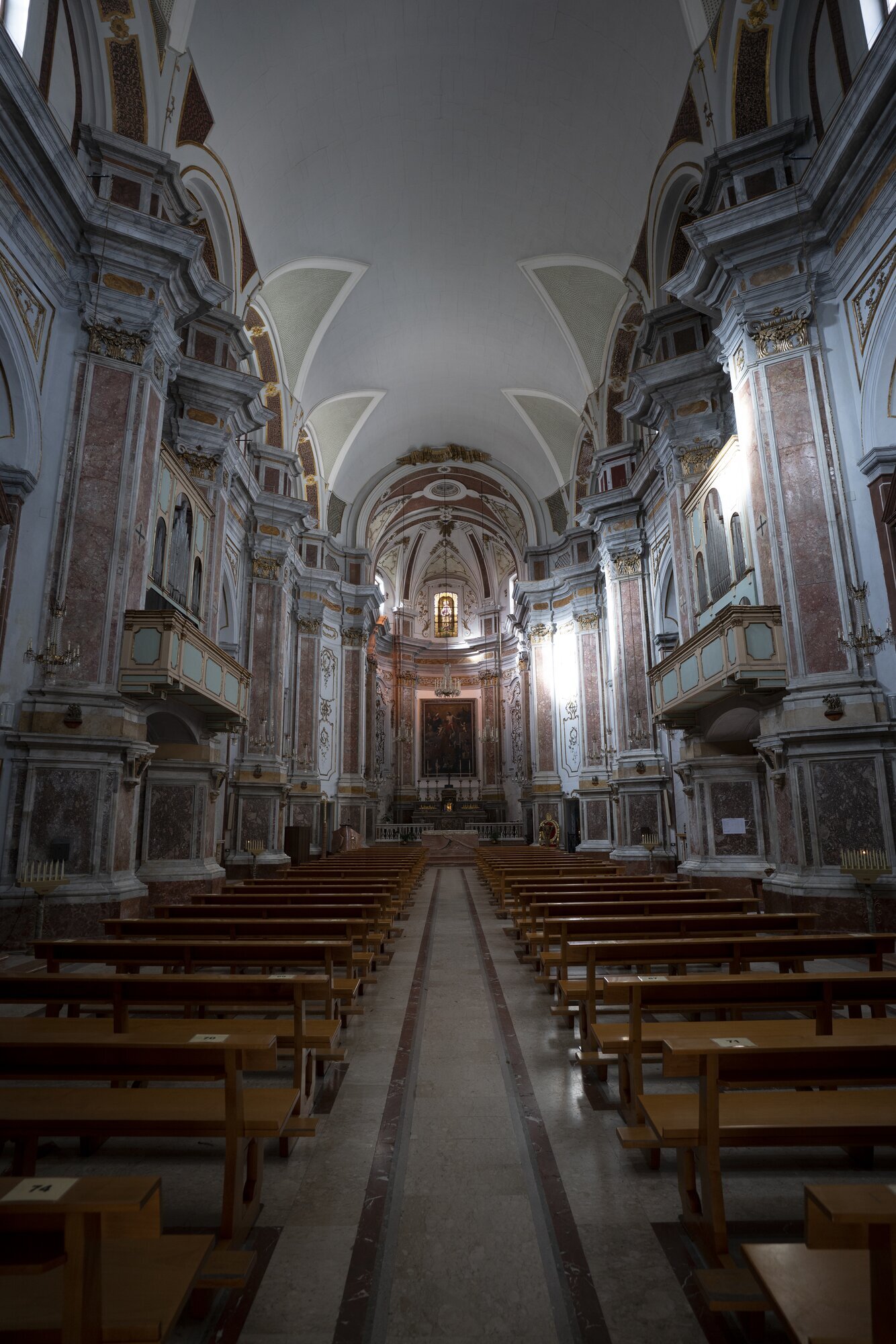
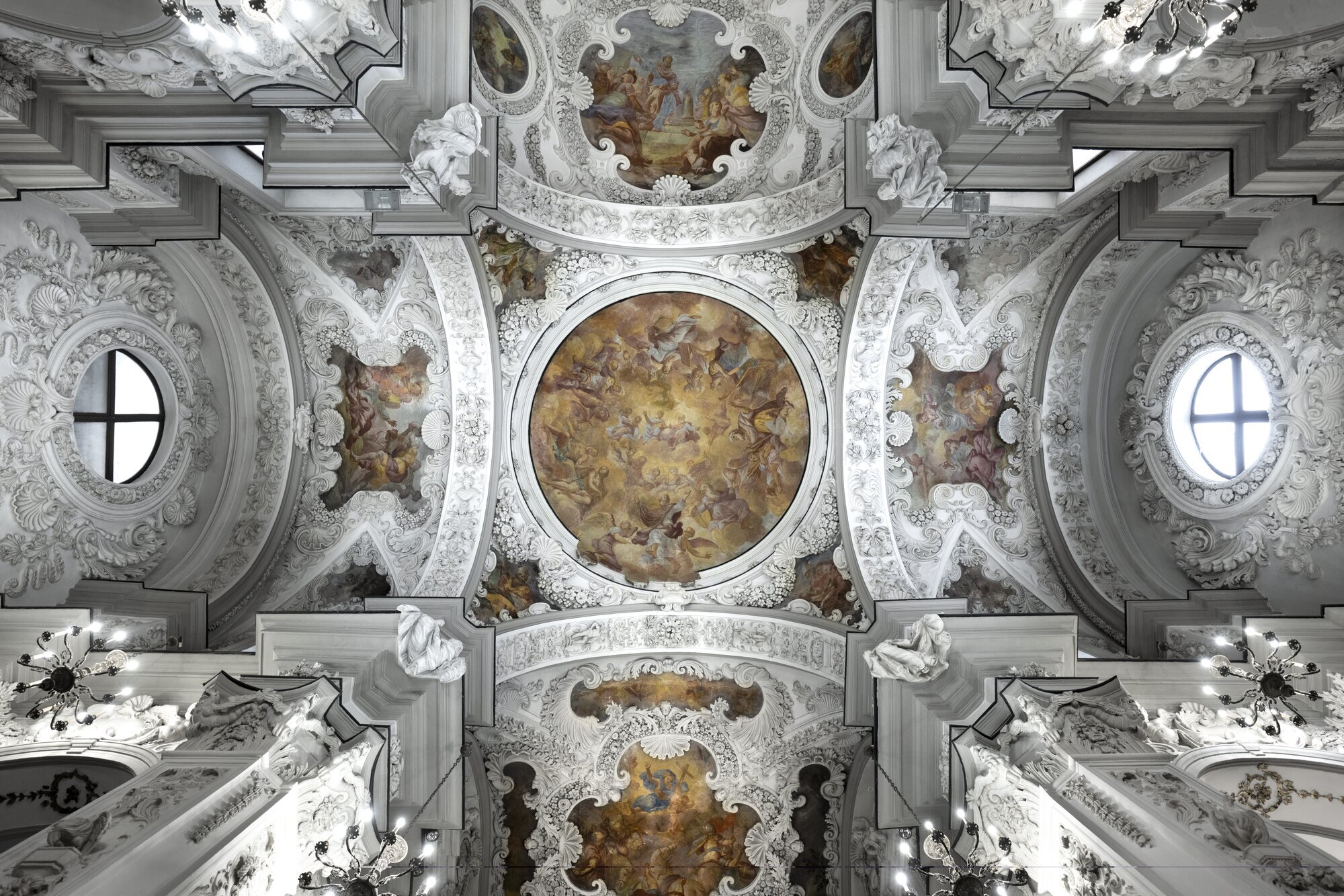
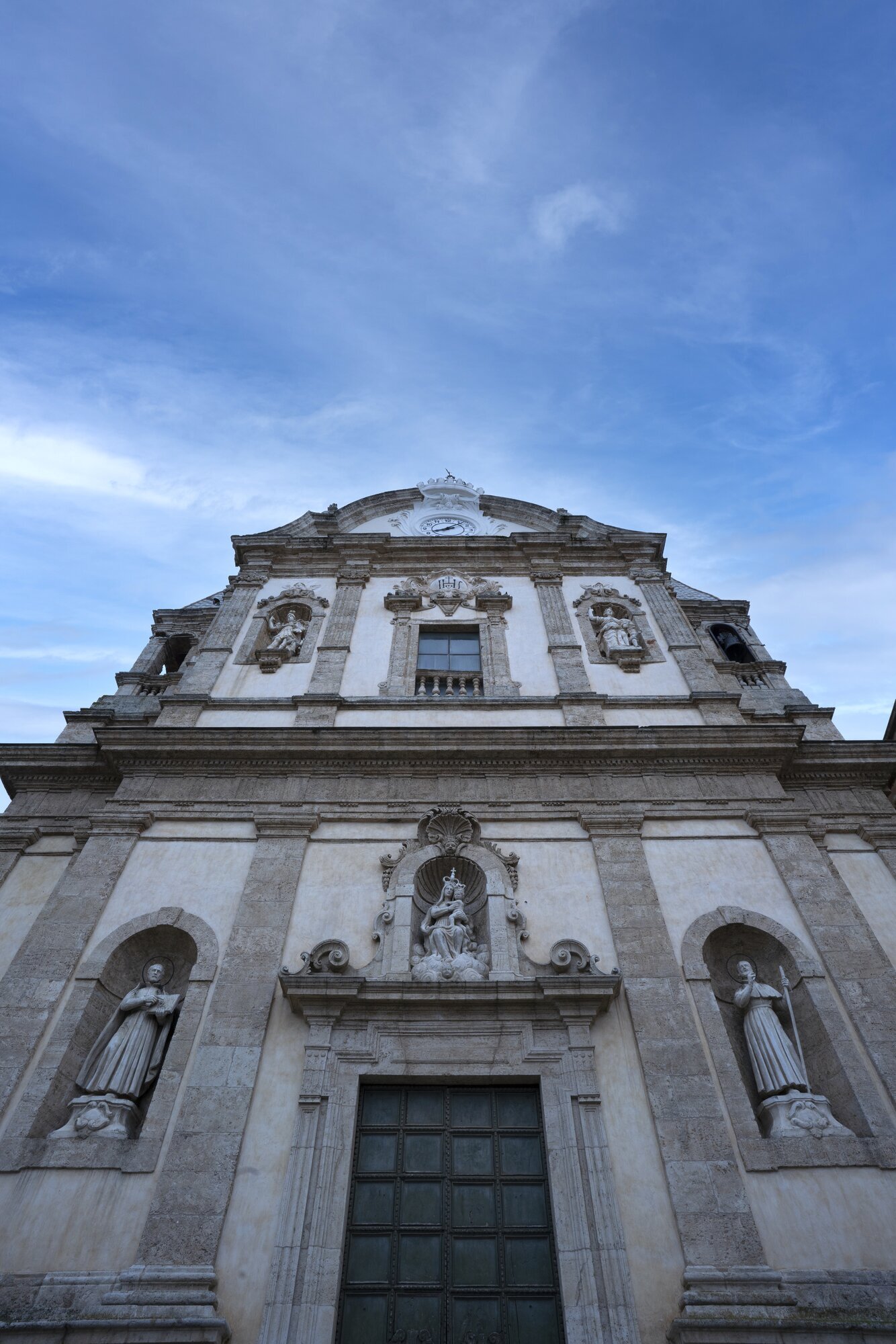
And then there are the two churches that, on their own, tell of Alcamo's artistic vein: the Church of the Jesuit College, with a façade that rises into the sky framed by two niches with saints, and an interior shaped by red marble columns leading the gaze to the altar; and the Church of Santi Paolo e Bartolomeo, where you only need to look up to lose yourself in a ceiling of stuccoes and frescoes that seem ready to slip down towards the viewer.


Cielo d'Alcamo, the voice of beginnings
Few know that one of the founding texts of Italian literature is tied to Alcamo. In the 13th century, Cielo d'Alcamo (also called Ciullo) lived or worked here, a poet of the Sicilian School and author of the celebrated dispute "Rosa fresca aulentissima": an ironic, popular love dialogue, among the very first verses ever written in vernacular Italian.
"Rosa fresca aulentissima ch'apari inver' la state…"
— Cielo d'Alcamo, 13th century
Walking through the historic centre, it's worth remembering that from these very streets, eight centuries ago, someone tried to express love in a new language.
Mount Bonifato and the Bosco d'Alcamo
At 825 metres above the town, Mount Bonifato is more than a backdrop: it's the green heart of Alcamo. The Bosco d'Alcamo Nature Reserve offers shaded trails among holm oaks, oaks and pines, with viewpoints that suddenly open onto the Gulf of Castellammare. Along the paths you encounter the ruins of the medieval village of Bunifat, the Swabian Castle of the Ventimiglia, the Chapel of the Madonna dell'Alto — a place of pilgrimage — and the Funtanazza, an ancient public cistern that bears witness to a sophisticated medieval water system.
This is a place that asks for time. A morning walk, a picnic in the shade, a silence broken only by the wind and the song of raptors circling above: the Bosco d'Alcamo gives back to those who visit the meaning of slow time.
The sea of Alcamo Marina
Barely five kilometres separate the town from the sea. Alcamo Marina, on the Gulf of Castellammare, stretches along nearly three kilometres of fine golden sand, with intact dunes and water that keeps its remarkable clarity. It's the beach for those who seek the sea without giving up the beauty of the inland landscape: morning on the shore, afternoon among the vineyards, evening in the cool of an old town square.
A short distance away, in Contrada Forgia, lie the evocative Roman Kilns: circular workshops from the imperial age (1st-5th century AD), where bricks, roof tiles, pottery and ceramics were produced. A precious trace of how this coast was already alive and productive almost two thousand years ago.
Bianco d'Alcamo, the wine of the land
Alcamo has its own way of meeting you at the table: it's called Bianco d'Alcamo DOC, and it's one of Sicily's most recognisable white wines. It's born from vineyards stretching as far as the eye can see between Bonifato and the coast, with a mineral freshness that tells of the region's stone, sea wind, sun filtered through hills. It pairs with fish from the marina, local cheeses, the fresh pasta still made by hand. From the belvedere of Piazza Bagolino you can see those very vineyards: a quick stop, but a defining one to understand where the flavour of this place comes from.
When to visit
Alcamo welcomes visitors all year round, but it has its perfect seasons.
Frequently asked questions about Alcamo
How much time should I spend in Alcamo?
A couple of hours' walk is enough for the historic centre, but to truly savour the town — castle, churches, viewpoints, perhaps a climb to the Bosco and a stop by the sea — at least a full day is best. Those who want to slow down can stay two or three days, alternating inland, coast and tastings.
How do I get to Alcamo?
Alcamo is easily reached via the A29 Palermo-Mazara del Vallo motorway, exits Alcamo Est or Alcamo Ovest. It lies about 50 km from both Palermo and Trapani, and 45 minutes from Palermo Punta Raisi airport.
What to see in Alcamo in one day?
Morning: visit the Castle of the Counts of Modica and walk along Corso VI Aprile with its churches (Basilica of Santa Maria Assunta, SS. Cosma e Damiano, Church of the Jesuit College). Lunch with local cuisine and a glass of Bianco d'Alcamo. Afternoon: a climb to the Bosco d'Alcamo on Mount Bonifato for the panorama, or alternatively the sea at Alcamo Marina.
Can I visit the Bosco d'Alcamo freely?
Yes, the Bosco d'Alcamo Nature Reserve is freely accessible, with marked trails. Walking shoes and water are recommended. The most striking spots are the Ventimiglia Castle and the Chapel of the Madonna dell'Alto.
Which church is a must-see in Alcamo?
Hard to choose just one. The Basilica of Santa Maria Assunta for the Borremans frescoes, the Church of SS. Cosma e Damiano for Serpotta's stuccoes, the Church of the Jesuit College for the dialogue between baroque façade and the rhythm of red marble inside. If you only have an hour, choose the basilica.
Where can I buy Bianco d'Alcamo?
Directly at many wineries in the area, but also in the wine shops of the historic centre. A stop at the belvedere of Piazza Bagolino lets you see the vineyards from above before a tasting.
Discover more
To explore the history, cultural initiatives and events of the area, visit the official website of the Municipality of Alcamo.
 Is not it what you were looking for? Review your choice


 Accommodation
 Event
Event
 All services
 How to get there
 Weather forecast