

locality
Gibellina

No other place in Sicily tells a story like this one: a town that dies and decides to be reborn not as it was, but as a work of art. On the night between 14 and 15 January 1968 the Belice earthquake razed old Gibellina, a medieval town of stone, to the ground. What happened next is without precedent — instead of rebuilding a copy, the community and its visionary mayor summoned Italy's greatest artists and architects and entrusted them with an impossible task: to bring a town back to life as a collective work.
The result is twofold and deeply moving. There is Gibellina Nuova, which rose eleven kilometres further down the valley, an open-air contemporary art museum with almost two thousand works scattered among its streets and squares. And there is Gibellina Vecchia, where the rubble has been wrapped in an immense shroud of white concrete — the Cretto di Burri. In 2026 Gibellina is Italian Capital of Contemporary Art, the first city to receive this title: recognition of a wager won over grief.
"I wanted, in a sense, to cement the town, to fix it just as it was, so that the memory of this tragedy would remain."
— Alberto Burri, on the Cretto
The Belice earthquake and the rebirth
The earthquake of January 1968 devastated a vast area of western Sicily, wiping out entire towns in the Belice valley and leaving tens of thousands of people homeless. Gibellina was among the hardest hit. During the years of reconstruction, mayor Ludovico Corrao had the intuition that would change the town's destiny: to transform tragedy into culture, calling on artists such as Pietro Consagra, Alberto Burri, Arnaldo Pomodoro, Mimmo Paladino, Mario Schifano and architects such as Ludovico Quaroni to design not merely buildings, but an idea of a town. Thus was born an urban experiment unique in the world.
The Cretto di Burri: walking inside memory
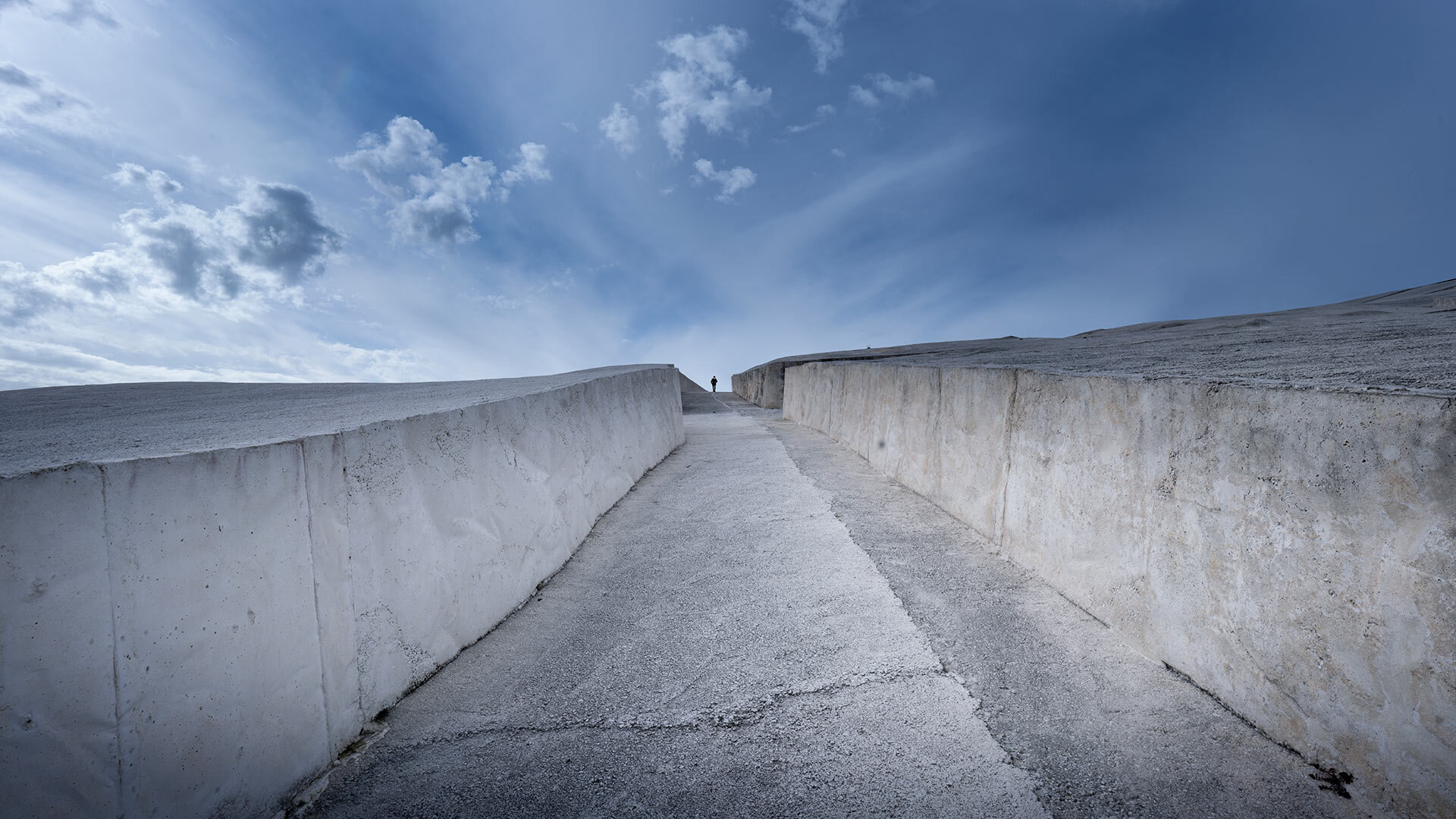
A few kilometres from the new town, on the hill where old Gibellina once stood, lies one of the largest works of land art in the world: the Cretto di Burri. Alberto Burri covered the rubble of the town with a pour of white concrete that preserves its plan exactly — the ancient alleys and blocks have become deep fissures you can walk through. Walking in the Cretto is a breathtaking experience: you cross the streets of a town that no longer exists, among blocks as tall as a person, in an absolute silence broken only by the wind. A monument to memory that is at once art, wound and prayer.
Gibellina Nuova, the town-museum
Arriving at the new town, you are greeted by the Stella del Belice, the enormous white steel star by Pietro Consagra that acts as a symbolic gateway to the town. From there Gibellina reveals itself as a widespread gallery: the Chiesa Madre by Ludovico Quaroni with its mysterious white sphere, the Sistema delle Piazze by Purini and Thermes, the Torre Civica that broadcasts the sounds of old Gibellina, and dozens of sculptures and installations by the masters of the twentieth century at every corner. The Baglio Di Stefano houses the Museo delle Trame Mediterranee, while the Museo Civico d'Arte Contemporanea guards the heart of the collection championed by Corrao.
The Orestiadi: classical theatre among the architecture
Since 1981 Gibellina has also been a stage: the Orestiadi are an international festival of theatre, music and visual arts that each summer brings the great classical tragedies and contemporary creation to life among the town's architecture and the spaces of the Baglio Di Stefano. Born from the desire to give voice to the rebirth, the Orestiadi have made Gibellina a cultural landmark well beyond the boundaries of Sicily, uniting ancient myth and the boldest experimentation.
When to go
Frequently asked questions about Gibellina
What is the difference between Gibellina Vecchia and Gibellina Nuova?
Gibellina Vecchia is the site of the medieval town destroyed by the 1968 earthquake, today covered by the Cretto di Burri. Gibellina Nuova is the town rebuilt eleven kilometres further down the valley, an open-air contemporary art museum. The two places are about twenty minutes apart by car: to understand Gibellina, you need to see both.
What is the Cretto di Burri and can it be visited?
It is a gigantic work of land art: Alberto Burri covered the rubble of old Gibellina with white concrete that preserves its plan. It can be visited freely, in the open air and free of charge, walking among the blocks along the ancient streets. Comfortable shoes, water and a hat are recommended: there is no shade.
How do you get to Gibellina?
By car from the A29dir (Palermo-Mazara), Salemi-Gibellina exit, then provincial roads. About an hour and a half from Palermo airport, about an hour from Trapani. A car is essential to reach both the new town and the Cretto.
Why is Gibellina Italian Capital of Contemporary Art 2026?
On 31 October 2024 Gibellina was proclaimed Italian Capital of Contemporary Art 2026, the first city to receive the title. A recognition of the unique experience of a town rebuilt as a collective work of art after the Belice earthquake.
When do the Orestiadi take place?
The Orestiadi take place in summer, with a programme of theatre, music and contemporary art performances among the architecture of Gibellina and the Baglio Di Stefano. The festival has existed since 1981; it is worth checking the dates and booking for the current season.
How much time do you need to visit Gibellina?
A full day allows you to see the Cretto in the morning and the town-museum in the afternoon. Those who love art and want to explore the museums and all the installations at leisure can devote two days to it.
Find out more
For institutional information, the Orestiadi calendar, museum opening hours and visitor services, consult the official website of the Municipality of Gibellina.
 Is not it what you were looking for? Review your choice


 Accommodation
 Event
Event
 All services
 How to get there
 Weather forecast