locality

Marsala

Marsala Marsala

There is a point, at the far west of Sicily, where the land stretches out into the sea and Africa feels just a step away: it is Capo Boeo, the island's westernmost tip, and there stands Marsala. The Carthaginians founded it around 397 BC and called it Lilybaeum; the Arabs, centuries later, gave it the name it still bears — Marsà Allah, "harbour of God". A frontier city of the sea, made of low light, salt and wine.

Marsala is two inseparable things at once: history and wine. Here, on 11 May 1860, Giuseppe Garibaldi landed with the Thousand and lit the spark of Italian Unification. And here, a century earlier, English merchants had discovered a robust, golden wine they would make famous around the world. Among the ruins of Lilybaeum, the barrels of the historic cellars, the Stagnone lagoon with the island of Mozia and the windmills of the salt pans, Marsala is the luminous, salt-kissed finale of western Sicily.

"Here, on 11 May 1860, the Thousand landed and the expedition that would unite Italy began." And still today Marsala is the island's western gateway.
— From the city's history

The old town and the landing of the Thousand

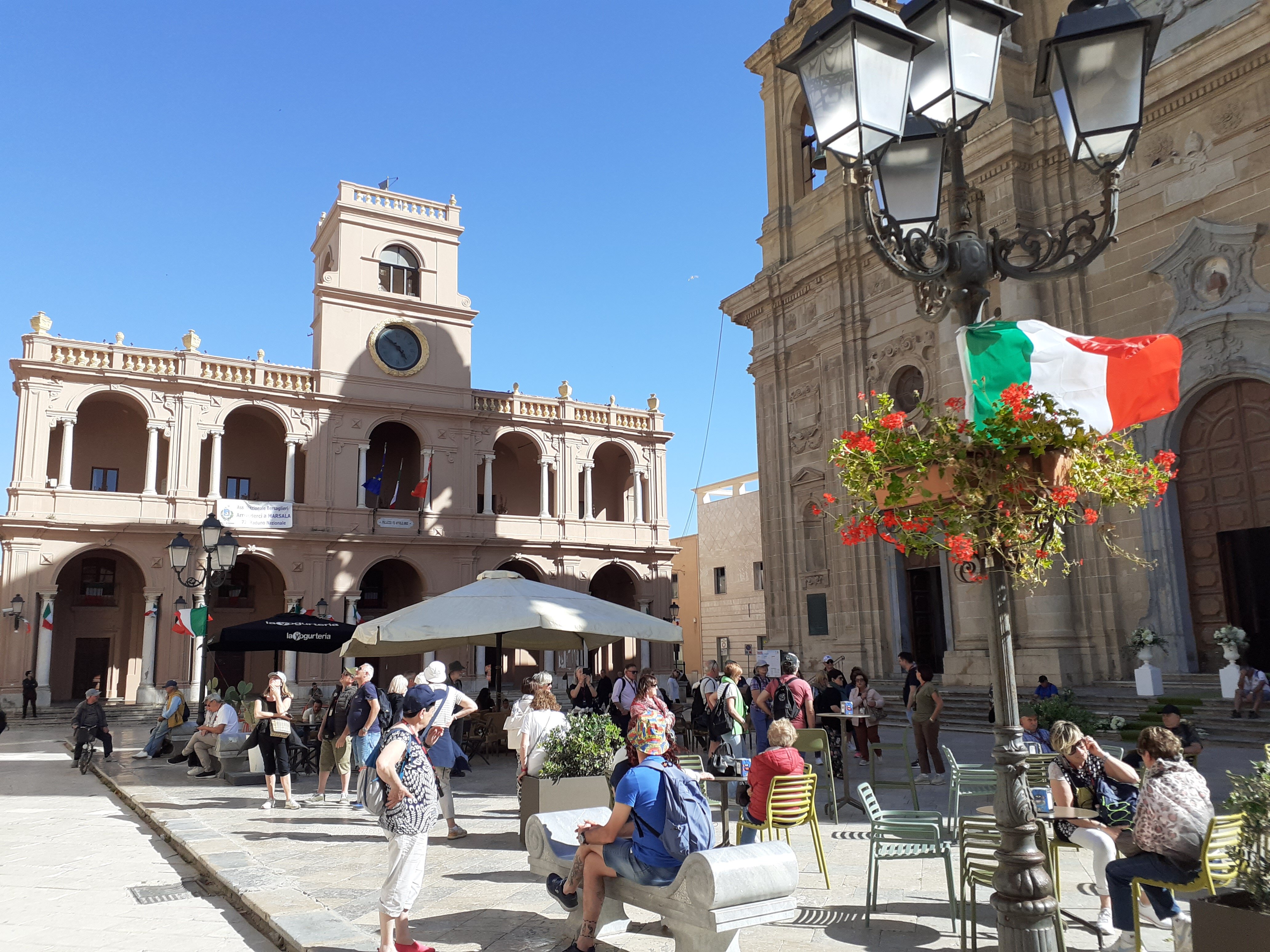
The heart of Marsala is an elegant Baroque parlour opening onto Piazza della Repubblica, dominated by the Cathedral dedicated to Saint Thomas of Canterbury and the eighteenth-century Palazzo VII Aprile with its loggia. You enter the city through Porta Garibaldi and Porta Nuova, ancient gateways in the walls. It was right here that, on 11 May 1860, Giuseppe Garibaldi landed with the Thousand, who had sailed from Quarto aboard the steamships Piemonte and Lombardo: the event that launched the expedition for Italian Unification, now recounted through relics and memories in the Garibaldi Museum. To walk these streets is to cross two thousand years of history in just a few steps.


Lilybaeum, Capo Boeo and the archaeological park

At the tip of Capo Boeo lies the Lilybaeum-Marsala Archaeological Park, where the Punic and Roman city resurfaces. You walk along the decumanus maximus, the ancient main street, and visit the Roman Insula with the remains of a luxurious domus complete with baths and splendid fourth-century mosaics. Nearby, the Baglio Anselmi Regional Archaeological Museum guards its most precious treasure: the Punic ship, the wreck of a third-century BC Carthaginian warship, a unique witness worldwide to the naval battles fought in these waters. Here Sicily ends, and its most ancient history rises from the earth.

Lilybaeum Archaeological Park — at Capo Boeo, with the Roman Insula, the mosaics and the Sibyl's Cave.
Baglio Anselmi Museum — home to the famous Punic ship of the 3rd century BC, a find unique in the world.
Island of Mozia — the ancient Phoenician Mothia in the Stagnone lagoon, with the Whitaker Museum.
Stagnone salt pans — basins and windmills (Ettore and Infersa) with unforgettable sunsets.


Marsala wine and the historic cellars

The name of this city is, the world over, synonymous with a wine. It all began in 1773, when the English merchant John Woodhouse, having put in by chance at Marsala, discovered the local wine and fortified it with alcohol so it could travel all the way to England: thus was born Marsala, golden and fortified, soon beloved even by Admiral Nelson. Following Woodhouse came Ingham and Whitaker, and in 1833 the entrepreneur Vincenzo Florio founded the cellar that would make Marsala famous worldwide. Today the wine is DOC since 1969, made with Grillo, Catarratto and Inzolia grapes in the Oro, Ambra and Rubino styles. The Florio Cellars and the other historic bagli can be visited among century-old barrels and the scent of wood and sea.


Mozia and the Stagnone lagoon

Before Marsala stretches the Stagnone, the largest coastal lagoon in Sicily, now a Nature Reserve: an expanse of shallow, luminous water sheltering four islands. The most famous is Mozia, the ancient Phoenician Mothia founded in the eighth century BC on the island of San Pantaleo, a thriving trading post destroyed in 397 BC by Dionysius of Syracuse. Brought back to light in the early twentieth century by the Englishman Joseph Whitaker — who had grown wealthy from the Marsala wine trade — the island today holds the Whitaker Museum and its masterpiece, the Young Man of Mozia, a refined Greek marble statue. You reach it by a short boat crossing, suspended between sky and water.


The salt pans, the sunsets and the flavours

Between Marsala and Trapani, along the Salt Road, the salt pans trace a landscape of geometric basins, white mounds and windmills. The Ettore and Infersa salt pans, with their sixteenth-century mill, offer one of the most beautiful sunsets in the Mediterranean, when sky and water turn pink, gold and violet. And then there is the table: fish couscous, hand-rolled busiate, pane cunzato, the fish of the Stagnone and, of course, Marsala wine, a star in the kitchen too. In Marsala the salt, the sea and the wine always end up on the plate and in the glass.


When to go

Spring — the ideal season: perfect weather for the old town, Lilybaeum, Mozia and the salt pans, and on 11 May the city remembers the landing of the Thousand.
Summer — sea and lagoon, kitesurfing on the Stagnone, trips to Mozia and fiery sunsets over the salt pans, with the city alive into the evening.
Autumn — the time of the grape harvest and the wine: golden light, still-warm sea, cellar visits and a peaceful atmosphere.
Winter — mild weather, an intimate old town, Marsala tastings and flavours of the sea: the most authentic, unhurried side of the city.

Frequently asked questions about Marsala

How much time do you need to visit Marsala?

For the old town, the Lilybaeum park at Capo Boeo and the Baglio Anselmi Museum with the Punic ship, a full day is enough. Adding a visit to the historic cellars, an excursion to Mozia in the Stagnone lagoon and a sunset at the salt pans, two or three days let you enjoy Marsala at a relaxed pace.

Where did Garibaldi land in Marsala?

Giuseppe Garibaldi landed at Marsala on 11 May 1860 with the Thousand, who had come from Quarto aboard the steamships Piemonte and Lombardo. The landing launched the expedition for Italian Unification. The Garibaldi Museum in the city preserves relics and testimonies of it.

Can you visit the Marsala wine cellars?

Yes. Several historic cellars, including the famous Florio Cellars, offer guided tours and tastings of the fortified wine. Marsala has been DOC since 1969 and comes in the Oro, Ambra and Rubino styles. It is best to book the visit in advance.

How do you reach the island of Mozia?

The island of Mozia (San Pantaleo), in the Stagnone lagoon, is reached by a short boat crossing from the jetties on the coast between Marsala and Trapani. On the island you can visit the Whitaker Museum, home to the famous Young Man of Mozia, and the Phoenician archaeological area.

When is the best time to see the salt pans?

The Stagnone salt pans, with the Ettore and Infersa pans and their windmills, are at their best at sunset, when the basins turn pink and gold. The Salt Road between Marsala and Trapani is ideal to travel slowly in the late afternoon. Guided tours of the working salt pans are available.

What to eat in Marsala?

The signature dishes are fish couscous, hand-rolled busiate and pane cunzato, accompanied by the fresh fish of the Stagnone. Not to be missed is Marsala wine, used in cooking and desserts too. Try the almond sweets and the granita.


Find out more

For official information, events, museum opening hours and visitor services, see the official website of the Municipality of Marsala.

Related content

Between Mount Bonifato and the sea, a mosaic of golden stone, vineyards and far horizons

Alcamo

A town that tells its story from the heights of its mountain and mirrors itself in the Gulf of Castellammare. Medieval castles, baroque churches and the bright fragrance of its most celebrated wine await those who choose to explore it slowly.

Buseto Palizzolo

A walk inside the scents and colors of a city garden.

Calatafimi Segesta

A Journey Through Time in the Heart of Sicily

Campobello Di Mazara

The dense foliage of centuries-old olive trees characterises the landscape of this town

The Arab-Norman port town overlooking the gulf, between the fortress by the sea, the sea stacks of Scopello and the Zingaro Reserve

Castellamare Del Golfo

A castle that has guarded the port since the Middle Ages, an old town climbing up from the sea in steps, the sea stacks of Scopello and the gateway to the Zingaro Reserve. Castellammare del Golfo is the fishing town where western Sicily, Mediterranean history and nature meet in a single view.

Castelluzzo

Small jewel that constitutes the wildest side of San Vito Lo Capo.

Castelvetrano

Pure uncontaminated nature

The marble town at the foot of Monte Cofano, between the sanctuary of the Madonna who arrived by sea and the living nativity of the Mangiapane Cave

Custonaci

A Marian sanctuary that guards a painting attributed to the school of Antonello da Messina, a troglodyte village where every Christmas the most evocative living nativity in Sicily comes to life, the Monte Cofano Nature Reserve and a hundred marble quarries. Custonaci is intimate, devoted western Sicily.

The medieval town suspended at 751 metres, between the temple of Venus and the cobblestone alleys overlooking the Mediterranean

Erice

A Norman castle built on the ruins of the temple of Venus Erycina, a medieval town of stone alleys vanishing into the mist, the view from the Balio Gardens all the way to the Egadi Islands. Erice is western Sicily seen from 751 metres up, where every century has left a tower.

Favignana

The largest of the Egadi islands

The town destroyed by the earthquake and reborn as an open-air contemporary art museum, between Burri's Cretto and the works of the great masters of the twentieth century

Gibellina

A town razed to the ground by the Belice earthquake and rebuilt as a single, immense work of art: the Stella di Consagra that serves as its gateway, the great white sphere of the Chiesa Madre, and a few kilometres away the Cretto di Burri, the concrete shroud enveloping the ruins of the old town. Gibellina, Italian Capital of Contemporary Art 2026.

Egadi

Favignana, Marettimo, Levanzo: the islands of treasures

Levanzo

Small and wild

Macari

Macari, along with Castelluzzo, is a fraction of San Vito Lo Capo.

Marettimo

Uncontaminated nature

The town where Sicily turns into Africa, among the Arab alleys of the Kasbah, the Dancing Satyr brought back from the sea and the largest fishing fleet in Italy

Mazara del Vallo

A maze of Islamic-flavoured alleys where Arabic still echoes, a Greek bronze fished up from the deep that dances alone in a museum, a Baroque cathedral grown over a mosque, and four hundred trawlers bringing home the famous red prawn every day. Mazara del Vallo is the point where Europe touches Africa.

Sicily's youngest municipality, a mosaic of hamlets among the salt pans, the golden beaches of Marausa and the sea-scented countryside south of Trapani

Misiliscemi

Born in 2021 from the union of eight ancient hamlets, Misiliscemi is not a town but a territory: the long beach of Marausa facing the Stagnone lagoon, the salt pans of Salinagrande, the farming districts with Arabic names and the airport that is the gateway to western Sicily. Authentic Sicily, the kind you live rather than visit.

Paceco

Windmills, salt flats, pink flamingos. It sounds like a movie, but it's all true

Pantelleria

The black pearl of the Mediterranean

Partanna

The medieval village surrounded by nature

Petrosino

Nestled and looking towards a transparent sea

Poggioreale

"The ruins that mark a people"

Zingaro Nature Riserve

The first nature reserve established in Sicily is an untouched paradise of cliffs plunging into the sea

Salaparuta

The sign of a violent earthquake.

The first capital of Italy for a single day, one of the most beautiful villages in Italy suspended over the hills of the Belice, between Garibaldi's castle, the ruins of the Mother Church an

Salemi

A Norman-Swabian castle where Garibaldi was the first to raise the Italian tricolour, making Salemi the first capital of Italy; a Mother Church reduced to an open-air stage set by the Belice earthquake and reinvented by Álvaro Siza; the Arab and Jewish alleys of the old town and the votive breads of San Giuseppe. Salemi is the Sicily of history and of bread.

A golden ribbon of sand between Monte Monaco and the Zingaro Reserve, where Sicily meets its most transparent sea

San Vito Lo Capo

Sicily's most photographed beach, a sanctuary-fortress that has watched over the village since the sixteenth century and one of the most enchanting nature reserves in the Mediterranean. San Vito Lo Capo is discovered slowly, barefoot between the white of the houses and the turquoise of the sea.

Santa Ninfa

A unique nature reserve

The sickle-shaped city stretching out between two seas, among salt pans dotted with windmills, the Misteri of Good Friday and the harbour from which you set sail for the Egadi

Trapani

A strip of land squeezed between two seas, salt pans that turn to gold and pink at sunset, windmills that grind PGI salt, the longest Misteri procession in Italy and the harbour from which hydrofoils depart for Favignana. Trapani is the beguiling, salt-tinged capital of western Sicily.

Valderice

A dip in the blue sea, a ride in the hills, 4 steps in history: the traveler's triathlon.

Vita

In the green lung of western Sicily: the Baronia forest.

We anticipate your questions

Plan your holidays

We designed this site to help you plan the perfect holiday.
Find all the information you need in one place. 
Have questions? Contact us directly for assistance.

Thank you

We’ve sent you an email. To activate the newsletter, click on the link you will find in the message. Thank you!

Something went wrong

Try again

Mistake