

locality
Pantelleria

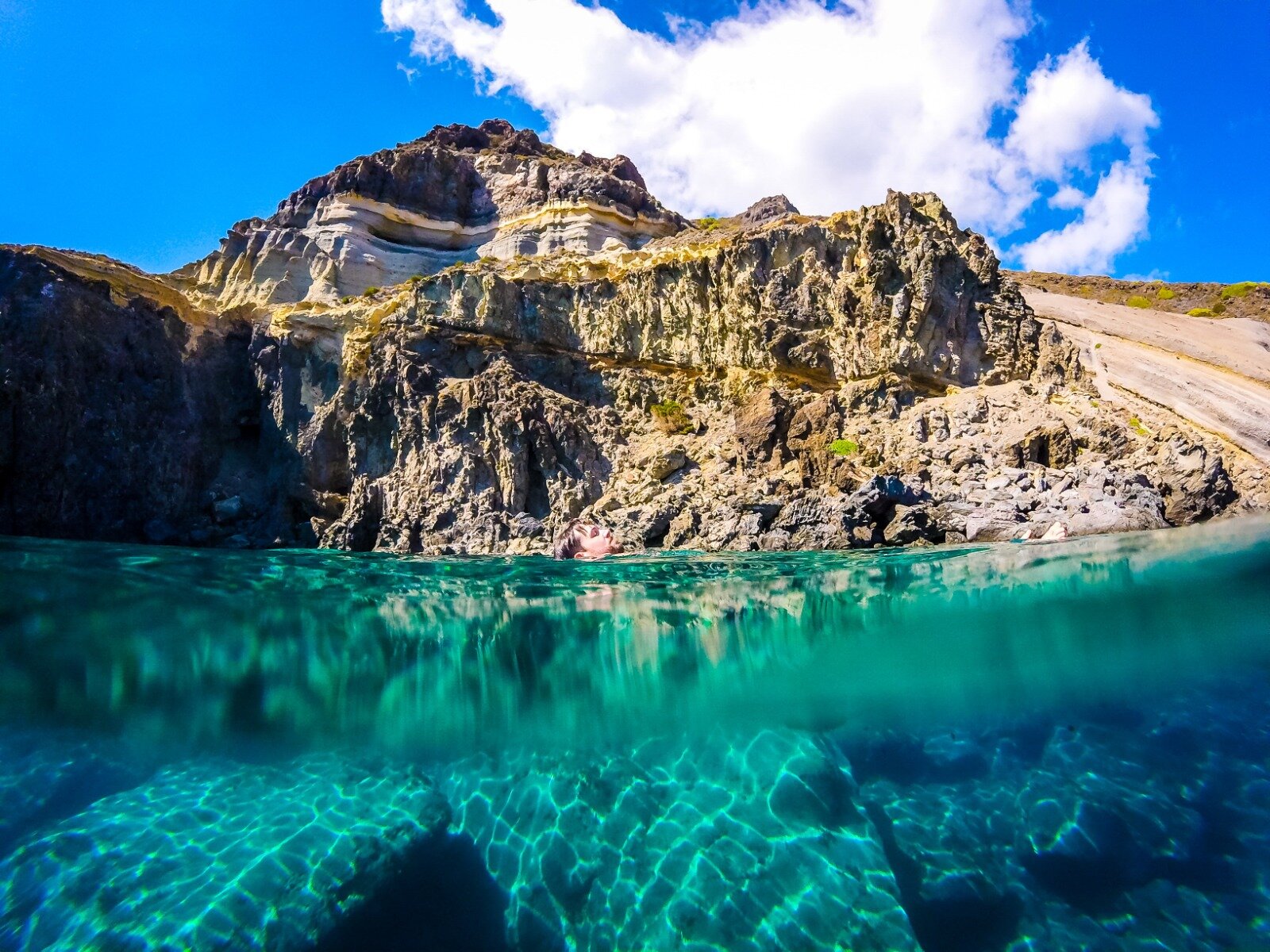
There is an island quite unlike any other in Sicily: it has no sandy beaches but cliffs of black lava, none of the clamour of tourism but the silence of the wind. Pantelleria rises from the Strait of Sicily closer to Africa than to the Sicilian mainland, a volcanic cone of dark stone where everything — the houses, the walls, the vineyards — was born of the stubborn dialogue between people, rock and wind.
They call it the Black Pearl of the Mediterranean, and the name says it all: the lustrous darkness of the lava stone, the dammusi with their white domes clinging to the slopes, the bush-trained vineyards grown in sheltered hollows — a farming gesture so skilful it became a heritage of humanity. Here you drink Zibibbo Passito, gather capers, bathe in the thermal waters of the Mirror of Venus and gaze at the sea from the Elephant Arch. This is an island you do not simply visit: you listen to it.
"Daughter of the wind", the ancients called it. And still today Pantelleria lives on the wind, the lava and a beauty that is hard-won.
— From the soul of the island
The volcanic island and the dammusi
Pantelleria is an entirely volcanic island, the largest of Sicily's minor islands, suspended in the Strait of Sicily a little over seventy kilometres from the coast of Tunisia. You will find no sand here, but a landscape of lava shaped by centuries of wind: sheer cliffs, coves of black pebbles, terraces and dry-stone walls. The symbol of the island is the dammuso, the ancient cubic house of lava stone with a white domed roof — a legacy of Arab architecture — designed to collect rainwater and shelter from the heat and the tramontana wind. Thick walls, small windows, white against black: the dammuso is the very image of Pantelleria.
Zibibbo, Passito and the UNESCO bush-trained vine
If one gesture captures the island more than any other, it is that of the farmer cultivating the bush-trained vine: low plants grown in small hollows dug into the ground to protect them from the wind and retain moisture. This traditional practice of cultivating the bush vine of Pantelleria was inscribed in 2014 on the UNESCO List of the Intangible Cultural Heritage of Humanity — the first farming practice in the world to receive such recognition. From here comes Zibibbo (Muscat of Alexandria), an aromatic grape that, dried in the sun, gives life to the celebrated Passito di Pantelleria DOC and to Moscato: golden, sweet and intense wines that smell of apricot, honey and the sea.
The Mirror of Venus, the Elephant Arch and the lava landscapes
Pantelleria's nature is spectacular and primeval. The Mirror of Venus (Specchio di Venere), a lake set in an ancient volcanic caldera, shifts in colour from green to turquoise and holds hot springs and thermal mud along its shore. The Elephant Arch (Arco dell'Elefante), a lava rock dipping its "trunk" into the sea, is the island's icon. Inland rises Montagna Grande, the extinct crater and highest point of the island, while on the north-west coast the mysterious Sesi tell of an ancient past. This is an island to explore slowly, on foot or by boat, discovering hidden coves and views that reach as far as Africa.
Capers, the Pantelleria gardens and the island's flavours
Pantelleria's lava soil yields intense, unmistakable flavours. The Caper of Pantelleria IGP is the most famous: picked by hand bud by bud and preserved in salt, wonderfully fragrant, it is the star of the island's cuisine. Among the vineyards survive the Pantelleria gardens, circular dry-stone enclosures that shelter a single citrus tree from the wind — small masterpieces of peasant ingenuity. At the table, fish reigns, along with the insalata pantesca (potatoes, tomatoes, capers and onion), Pantelleria pesto and the baci panteschi, fried sweets filled with ricotta: the cuisine of an island that blends Sicily and Africa in every dish.
The favare, the thermal springs and the National Park
Pantelleria is an island still alive beneath its surface, as the favare reveal: fumaroles from which hot water vapour rises, visible above all in the morning, along with its many thermal manifestations. At the Grotta di Benikulà (the "natural sauna" of Sibà) hot steam escapes from the rock, offering a bath of warmth with a view over the sea, while springs and coves of tepid water open along the coast. To protect this unique heritage, the Pantelleria Island National Park was created in 2016 — the first national park in Sicily — safeguarding about eighty per cent of the island, among vineyards, dry-stone walls and volcanic nature.
When to go
Frequently asked questions about Pantelleria
How do you get to Pantelleria?
Pantelleria can be reached by air, with flights from Sicily (Trapani, Palermo, Catania) and, in summer, from several Italian cities, or by sea on the ferries from Trapani (a crossing of a few hours). The airport is just a few kilometres from the town.
What is a dammuso?
The dammuso is the typical house of Pantelleria: a cubic dwelling of dry lava stone, with thick walls and a white domed roof to collect rainwater. It is a legacy of Arab architecture, and today many dammusi have been restored as accommodation for visitors.
Why is the bush-trained vine a UNESCO heritage?
In 2014 the traditional practice of the bush-trained vine of Pantelleria was inscribed on the UNESCO List of the Intangible Cultural Heritage of Humanity: it was the first farming practice in the world to receive this recognition, for the skill with which the vines are grown low in hollows sheltered from the wind.
Are there beaches on Pantelleria?
Pantelleria has no sandy beaches: being volcanic, it offers coves and cliffs of lava rock, pebble inlets and natural pools. You swim by diving from the rocks or in the coves; also not to be missed is the thermal lake of the Mirror of Venus.
What to eat and drink on Pantelleria?
The signature flavours are the Caper of Pantelleria IGP, the insalata pantesca, fish, Pantelleria pesto and the sweet baci panteschi filled with ricotta. To drink, the Passito di Pantelleria DOC and Moscato, made from the Zibibbo grape: among the most celebrated sweet wines in Italy.
What are the favare and the natural sauna?
The favare are fumaroles, cracks in the rock from which hot water vapour escapes, a sign of still-active volcanism. At the Grotta di Benikulà, in Sibà, the natural steam creates a true "sauna" set in the landscape, with a spectacular view over the sea.
Discover more
For official information, visitor services and news about the island, see the official website of the Municipality of Pantelleria.
 Is not it what you were looking for? Review your choice


 Accommodation
 Event
Event
 All services
 How to get there
 Weather forecast